
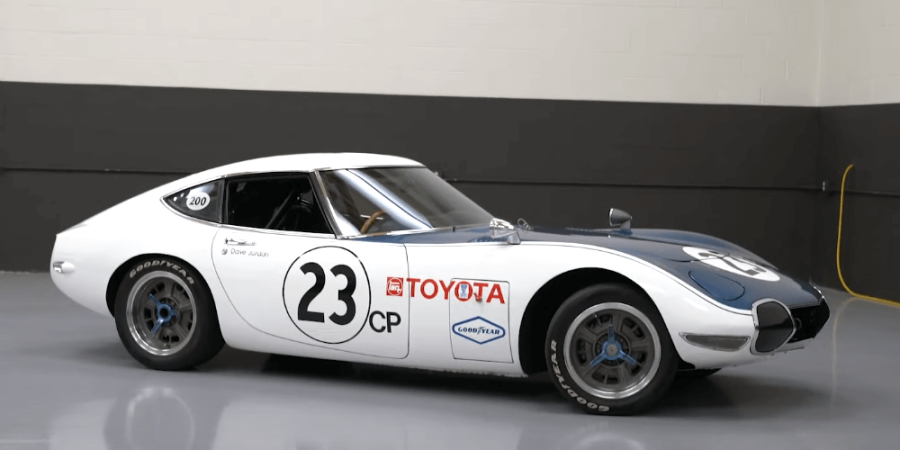
The Toyota-Shelby 2000GT stands as the most expensive JDM car ever sold, achieving a record-breaking $2.535 million at Gooding & Company’s Amelia Island auction in 2022. You’ll find this rare masterpiece features a 2.0L inline-six engine producing 150 bhp at 6600 rpm, wrapped in a lightweight body with a 91.7-inch wheelbase.
Only 337 units were produced between 1967 and 1970, including three Shelby-built racing versions, making it exceptionally scarce. Originally priced at $7,150 ($63,367 adjusted), the 2000GT’s value has skyrocketed due to its historical significance, engineering excellence, and racing pedigree. The full story behind this automotive legend reveals even more impressive details.
The Toyota-Shelby 2000GT Legacy
Breaking new ground in Japanese automotive history, the Toyota-Shelby 2000GT stands as the pinnacle of JDM engineering and value, with its record-breaking $2.535 million auction price in 2022.
Born from the collaborative genius of Toyota’s Satoru Nozaki and influenced by Raymond Loewy’s design principles, this rare masterpiece seamlessly blended design influences from both European and American sports cars of its era. Its graceful dimensions included a wheelbase of 91.7 inches, making it perfectly proportioned for both road and track use.
You’ll find the 2000GT’s racing heritage deeply rooted in Carroll Shelby’s expertise, who built just three racing versions. Under the sleek, low-slung bodywork, the car packed a sophisticated 2.0-liter inline-six engine producing 150bhp at 6600rpm.
The powertrain mated to a 5-speed all-synchromesh gearbox, could propel the car to 144 mph in racing trim. With only 337 units produced between 1967 and 1970, the 2000GT commanded a premium price of $7,150 – surpassing both the Jaguar E-type and Porsche 911 of its time.
The car’s independent suspension and multiple rear axle ratio options showcased Toyota’s commitment to creating a world-class sports car that could compete with established European marques.
Record-Breaking Auction Sale
This legendary Toyota-Shelby 2000GT reached its pinnacle of recognition at Gooding & Company’s Amelia Island auction in March 2022, where it commanded an astounding $2.535 million, setting a new benchmark for Japanese automobiles at auction.
The bidding tactics employed during this historic sale demonstrated the market’s intense appetite for rare JDM vehicles, particularly those with documented racing pedigrees. The sale surpassed the previous record held by the 1989 Mazda 767B at $1.75 million.
| Performance Metrics | Original Spec | Racing Variant |
|---|---|---|
| Engine Output | 150 hp | Enhanced Output |
| Weight | 1,134 kg | Reduced Mass |
| Production Numbers | 351 Total | 3 Shelby Units |
You’ll find the auction strategies employed at Amelia Island particularly significant, as this 2000GT outperformed several European thoroughbreds, including a 2005 Porsche Carrera GT and a 1967 Ferrari 330 GTS.
The car’s exceptional provenance, being one of only three Shelby-prepared examples, coupled with its pristine condition and documented racing history, created perfect market conditions for this record-breaking sale. This transaction has fundamentally altered the collector car landscape, establishing Japanese classics as blue-chip investments comparable to their European counterparts.
Design and Engineering Excellence
Japanese engineering prowess shines through in the 1967 Toyota-Shelby 2000GT’s masterful blend of form and function. The Satoru Nozaki-designed coupé exemplifies design innovation through its sleek proportions and racing-inspired aerodynamics, while engineering precision is evident in every aspect of its construction.
The car’s 2.0L six-cylinder engine produced an impressive 138 bhp. You’ll find cutting-edge features throughout the vehicle, showcasing JDM’s commitment to technical excellence. The lightweight construction techniques, including thinner-gauge steel applications, demonstrate the sophisticated approach to performance optimization that has become synonymous with Japanese automotive engineering.
Notable engineering achievements in JDM vehicles include:
- Advanced engine management systems optimizing performance across various driving conditions
- Sophisticated suspension geometries providing enhanced stability and handling characteristics
- Precision-engineered powertrains delivering exceptional power-to-weight ratios
- Aerodynamic innovations reduce drag while maintaining stability at high speeds
The engineering excellence extends to modern JDM vehicles, with examples like the Lexus LFA Nürburgring Edition’s 4.8L V10 engine, capable of reaching 9,000 rpm in 0.6 seconds.
These technical achievements highlight why JDM vehicles command such high values in today’s collector market, with the 2000GT leading the pack at $2.535 million.
Limited Production Numbers
Manufacturing scarcity plays a pivotal role in the astronomical values of JDM vehicles, with production numbers heavily restricted by both voluntary industry limitations and strict regulatory frameworks.
You’ll find that until 2004, Japanese automakers adhered to a self-imposed limit of 280 PS and 300 km/h top speeds, creating an entire generation of performance-restricted vehicles that are now highly sought after.
Production scarcity isn’t just about voluntary limitations, though. Japan’s stringent motor vehicle inspection system and complex export controls have created natural barriers that limit availability.
When you’re examining collector demand, you’ll notice it’s particularly intense for models that were never officially exported, such as certain Skyline GT-R variants and limited-edition Type R models.
The impact of Japan’s bubble economy in the 1990s further complicated matters, as manufacturers produced several high-performance vehicles in extremely limited numbers. The strict 180 km/h limit on both cars and motorcycles has made unrestricted JDM models particularly valuable to collectors.
Today, these restrictions have created a perfect storm in the collector’s market, where authentic, low-production JDM cars command premium prices due to their rarity, historical significance, and the growing global appreciation for Japanese automotive engineering excellence.
Restoration and Preservation
While preserving a high-value JDM car requires meticulous attention to detail, proper restoration demands an even higher level of expertise and dedication.
You’ll need to implement proven restoration techniques and preservation strategies to maintain your vehicle’s value and authenticity.
Critical steps in the restoration process include thorough initial inspections, careful disassembly, and precise documentation of each component.
You’ll face challenges sourcing rare JDM parts, which often require extensive networking with specialists and parts suppliers worldwide.
- Document every restoration phase with detailed photographs and records
- Source original equipment manufacturer (OEM) parts whenever possible
- Store your vehicle in a climate-controlled environment with 45-55% humidity
- Perform regular maintenance checks using factory-specified procedures
When implementing preservation strategies, you’ll need to focus on preventive measures rather than reactive solutions.
This includes applying appropriate protective coatings, using high-quality car covers, and maintaining proper storage conditions.
If you’re dealing with a particularly valuable model, consider consulting marque specialists who understand the unique characteristics of JDM vehicles and can provide expert guidance on period-correct restoration techniques.
Market Value Through Time
Since its 1967 debut at $7,150 (equivalent to $63,367 today), the Toyota 2000 GT‘s market value has skyrocketed to its record-breaking $2.535 million auction price in 2022.
You’ll notice the car’s appreciation curve has been particularly steep since 2014 when a standard 2000 GT fetched $1.155 million at Pebble Beach.
The Shelby connection and racing pedigree of the record-breaking example illustrate how provenance can dramatically impact JDM values, establishing benchmarks that influence the entire collector market.
Price Growth Since 1967
The dramatic price trajectory of Toyota’s 2000GT represents one of the most remarkable value appreciations in JDM history, soaring from its original 1967 U.S. price tag of $7,150 to a record-breaking $2.535 million in 2022.
This exponential growth reflects complex market dynamics, as the model’s initial premium pricing 15% higher than contemporary European sports cars like the Jaguar E-Type and Porsche 911, initially hindered sales but later contributed to its rarity and collectibility.
You’ll find the 2000GT’s price appreciation particularly evident through these milestone valuations:
- 1967: $7,150 (Original MSRP, equivalent to $63,367 today)
- 2013: $1,155,000 (RM Sothebys, Fort Worth)
- 2014: $1,155,000 (Gooding & Co, Pebble Beach)
- 2022: $2,535,000 (Current record holder)
The model’s value surge has been amplified by global market factors, including the weakening yen and increased demand for rare JDM vehicles.
With only 351 units produced and merely 62 sold in America, the 2000GT’s scarcity continues to drive its position as the most valuable Japanese classic car.
Historical Auction Record Breakers
Breaking auction records consistently, Japanese domestic market vehicles have ascended to unprecedented price levels, with the 1967 Toyota 2000GT leading the charge at $2.535 million. Auction strategies have evolved as collector demographics shift toward JDM appreciation, resulting in fierce bidding wars for rare specimens.
| Vehicle Model | Year | Sale Price |
|---|---|---|
| Toyota 2000GT | 1967 | $2.535M |
| Toyota GR Supra #1 | 2020 | $2.1M |
| Lexus LC500 VIN #100001 | 2021 | $2.0M |
| Lexus LFA Nürburgring | 2012 | $1.87M |
You’ll notice these record-breaking sales aren’t limited to vintage models. Modern classics like the first production GR Supra and LC500 have commanded seven-figure prices, demonstrating the market’s breadth. The LFA Nürburgring Edition’s $1.87 million sale particularly highlights how limited production runs and racing pedigree influence valuations.
Significantly, these prices reflect a substantial market evolution from when Japanese vehicles were considered merely affordable alternatives to European sports cars. The trajectory suggests continued growth in the high-end JDM market, especially for vehicles with documented provenance and historical significance.
Auction Process and Grading
Japanese car auctions follow a meticulous five-step process that’s vital for determining a vehicle’s true value and condition.
When you’re bidding on high-value JDM vehicles, understanding the thorough vehicle inspection and grading system is essential for making informed decisions.
The auction process relies on a standardized grading scale that ranges from S (near-perfect condition) to R (repaired), with expert inspectors evaluating every aspect of the vehicle.
You’ll need to pay close attention to:
- Exterior assessment: Panel alignment, paint condition, and accident history
- Interior evaluation: Upholstery wear, dashboard condition, and electronic functionality
- Mechanical inspection: Engine performance, transmission health, and underbody integrity
- Documentation verification: Service history, ownership records, and mileage authentication
For premium JDM vehicles, auction bidding often involves dealer-exclusive events accessible through authorized intermediaries.
Working with reputable brokers becomes particularly important when pursuing rare or high-value vehicles, as they can provide vital insights into a vehicle’s true market value and condition assessment.
Investment Opportunities in JDM
If you’re looking to invest in JDM vehicles, you’ll find that models like the Toyota Supra MK-IV and Nissan Skyline GT-R have demonstrated consistent value appreciation, with some examples seeing 30-40% increases over five-year periods.
While established icons command premium prices, lesser-known models such as the Mitsubishi Evolution VI Tommi Makinen Edition and Honda NSX Type-R present potentially lucrative opportunities due to their limited production numbers and growing collector interest.
Your investment strategy should carefully weigh historical sale data against market volatility, considering factors like import regulations, maintenance costs, and the vehicle’s originality certification when projecting potential returns.
Rising Values Over Time
Over the past decade, JDM vehicles have emerged as serious investment opportunities, with values skyrocketing well beyond their original purchase prices. Market analysis reveals impressive JDM trends, with vehicles in “fine” condition experiencing an 18.1% value increase over three years and a substantial 38.8% surge over five years. This growth outpaces the general automotive market, driven by intense collector demand and limited availability.
Key market performance indicators demonstrate the investment potential of JDM vehicles:
- Rare performance models like the Toyota Supra command six-figure prices, with documented sales reaching $199,800.
- Classic 4x4s, including the Toyota Land Cruiser, have achieved $100,000+ valuations with low mileage.
- The 25-year import rule creates artificial scarcity in the US market, driving up prices.
- Turbo-charged variants and manual transmission models consistently command premium prices.
The investment landscape continues to favour well-maintained, low-mileage examples, particularly those with documented history and original components.
This trend is particularly evident in performance-oriented models, where rarity combines with enthusiast demand to create sustained value appreciation.
The market shows no signs of cooling, with certain models like the Lexus LFA projected to appreciate greatly.
Hidden Gems Worth Watching
A savvy investor’s guide to JDM vehicles wouldn’t be complete without exploring several under-the-radar models that show promising investment potential. Current JDM trends indicate an average value appreciation of 18.1% over three years, with the market outperforming general automotive investments by 38.8% over five years.
Key opportunities exist in low-mileage specimens, exemplified by a Toyota Land Cruiser fetching $100,000 with just 5,000 miles on the odometer.
The kei car segment presents particularly interesting prospects, with models like the Autozam AZ-1, Honda Beat, and Suzuki Cappuccino becoming more accessible due to favourable exchange rates. Currently, collector communities are taking notice of these compact performers.
For strategic acquisition, consider that a 200,000 yen vehicle costs approximately $1,270 before import fees. However, total landed costs typically double when accounting for shipping, duties, and insurance.
Working with established exporters like JDM Garage UK can mitigate risks. The 25-year import rule creates natural scarcity for well-preserved examples, while Japanese owners’ meticulous maintenance practices often translate to superior condition vehicles, enhancing long-term value proposition.
Risk vs. Return Analysis
While exploring hidden gems reveals exciting opportunities, understanding the risk-return profile of JDM investments demands careful analysis. Your risk assessment must account for market volatility, parts availability, and regulatory compliance, particularly when considering rare models like the Toyota 2000 GT that command premium prices.
The return potential of JDM investments has proven significant, with appreciation rates reaching 38.8% over five-year periods. However, you’ll need to weigh these returns against substantial maintenance costs and potential importation challenges.
Key metrics to evaluate before investing in JDM vehicles:
- Historical appreciation rates (18.1% three-year average)
- Rarity factor and production numbers
- Vehicle condition and documentation
- Market demand indicators and cultural significance
Your investment strategy should focus on models with documented provenance, low mileage, and original components.
Consider that while flagship models like the Lexus LFA Nürburgring Edition have shown strong returns, they require significant capital outlay. Additionally, you’ll want to factor in specialist maintenance costs and storage requirements to maintain the vehicle’s value proposition over time.
Future Market Predictions
Market analysts project the JDM collector car market to experience substantial growth through 2028, with the rarest models like the Toyota 2000 GT expected to surpass $3 million at auction. This trajectory is supported by the forecasted CAGR of 6.28%, pushing the Japanese used car market to $84.9 billion within five years.
You’ll see a significant shift in market dynamics as digital platforms revolutionize how collectors acquire vintage Japanese automobiles. The increasing availability of value-added services, including specialized financing and extensive insurance packages, will make high-end JDM acquisitions more accessible to serious collectors.
Environmental considerations will reshape collecting trends, with hybrid and electric variants of classic JDM models potentially commanding premium prices.
You will likely witness heightened demand for limited-production vehicles, particularly those with documented racing heritage or significant historical provenance. However, you’ll need to factor in market volatility due to global economic uncertainties and rising interest rates, which could affect investment returns.
The market for luxury JDM vehicles remains particularly resilient, with models like the Lexus LFA Nürburgring Edition and rare Skyline variants projected to appreciate substantially.
Frequently Asked Questions
Why Did Carroll Shelby Choose to Modify Only Three Toyota 2000GTS?
You’ll find that Toyota’s $500,000 budget limited Carroll Shelby’s vision, which only allowed for three 2000GT race conversions. Two were actively raced while one served as a development prototype.
How Many Toyota 2000GTS Still Exist in Their Original Unrestored Condition?
You won’t find specific data on unrestored 2000GTs, as preservation efforts aren’t well documented. Most surviving examples have undergone restoration to maintain their value and drivability over time.
What Modifications Were Made Specifically for the James Bond Movie Version?
For Bond’s “You Only Live Twice,” Toyota created two custom convertible 2000 GTs with removed roofs and lowered windscreens to accommodate Sean Connery’s height. They also added movie-specific communications equipment and special paint.
Which Countries Currently Have the Highest Concentration of Toyota 2000GTS?
You’ll find the highest concentration of Toyota 2000GT collectors in Japan, where most right-hand drives remain, followed by the United States with 62 left-hand examples, and particularly, Germany’s Rhine Valley region.
Can Parts for the Toyota 2000GT Still Be Obtained From Toyota?
Yes, you can obtain Toyota 2000GT parts through Toyota’s GR Heritage Parts Project. They’ll reproduce and sell specific restoration components through authorized dealers, though you’ll need to prove ownership to purchase these limited-production parts.
Leave a Reply