
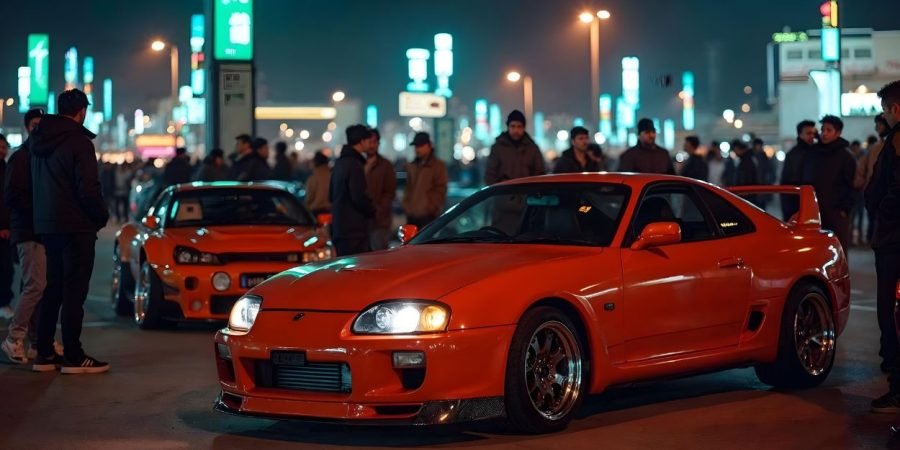
JDM (Japanese Domestic Market) culture traces its roots to post-World War II Japan and has evolved into a globally recognised automotive movement. Initially centred on domestic vehicle production, it later expanded to focus on performance improvements, unique modifications, and technical expertise.
The culture gained traction through underground racing, professional motorsports like Super GT, and iconic models such as the Nissan Skyline GT-R and Toyota Supra. JDM represents a passionate community where enthusiasts exchange technical insights, customise vehicles, and honour the principles of Japanese engineering.
Its influence persists, shaping global trends and propelling the aftermarket industry, which is anticipated to reach $152 billion by 2032. By delving into JDM’s history, one uncovers a legacy of innovation and a deep commitment to automotive excellence.
Highlights
- JDM (Japanese Domestic Market) culture is a dynamic automotive movement focused on Japanese-made vehicles, their modification, and performance enhancement.
- Emerging after World War II, the culture was shaped by manufacturers such as Toyota, Nissan, and Honda, which produced vehicles known for their reliability and innovation.
- JDM thrives on authenticity, community collaboration, and the exchange of technical knowledge among enthusiasts dedicated to refining and customising Japanese cars.
- Iconic models like the Nissan Skyline GT-R and Toyota Supra stand as enduring symbols of JDM ingenuity and engineering excellence.
- The movement blends street racing traditions, performance tuning, and aesthetic modifications, all while honouring the rich heritage of Japanese automotive craftsmanship.
Origins of The JDM Movement
The origins of the JDM (Japanese Domestic Market) movement can be traced to post-World War II Japan, where the automotive industry emerged as a cornerstone of the nation’s economic rebuilding efforts. During the 1950s and 1960s, manufacturers like Toyota, Nissan, and Honda began producing vehicles specifically tailored to meet domestic market demands and strict regulatory requirements.
The JDM history took a significant turn in the 1960s and 1970s when Japanese automakers intensified their focus on performance and reliability. This period witnessed the emergence of the underground “Kyuusha” culture, marking the beginning of systematic vehicle modification practices.
The Japanese youth culture heavily influenced the movement through underground racing events and car meets. The designs embraced minimalist aesthetics with clean lines and uncluttered exteriors, reflecting traditional Japanese principles. The cultural significance of JDM expanded as manufacturers introduced innovative technologies, including turbocharging and advanced engine management systems, responding to domestic market constraints such as displacement taxes and emissions regulations.
This technical evolution, coupled with Japan’s unique regulatory environment, fostered a distinctive automotive culture characterized by high-performance engineering and meticulous attention to detail. The development of specialized vehicles for the Japanese market, including Kei cars, further solidified the foundation of what would become a global phenomenon in automotive enthusiasm and modification culture.
Core Values and Philosophy
Within JDM culture, performance optimization stands as the paramount principle, with enthusiasts dedicating extensive resources to achieving maximum vehicle capability through meticulous modifications and tuning.
The culture’s foundation rests equally on a strong sense of community, where knowledge-sharing and mutual support drive collective growth among enthusiasts. Japanese automotive engineering’s emphasis on compact performance design has significantly influenced this culture’s development since the post-war era.
The movement particularly values engines with low mileage imports due to Japan’s strict vehicle inspection regulations, ensuring exceptional quality in the community. These dual pillars of performance excellence and communal respect create a distinctive automotive subculture that values both technical achievement and collaborative advancement.
Performance Above All Else
Performance lies at the heart of JDM (Japanese Domestic Market) culture, reflecting an unwavering commitment to automotive excellence that prioritises function over form. This focus on performance is realised through advanced engineering, innovative technology, and the exceptional tuning potential of Japanese vehicles.
Key elements of JDM’s performance-driven ethos include:
- Engine Tuning: Utilising systems like turbocharging and VTEC for significant power gains and efficient performance.
- Lightweight Design: Incorporating weight reduction techniques and aerodynamic features to optimise power-to-weight ratios.
- Enhanced Vehicle Dynamics: Advancing suspension, braking, and drivetrain systems to achieve superior handling and stability.
- High-Performance Models: Developing specialised variants tailored for enthusiasts and motorsport demands.
The culture’s emphasis on innovation and refinement has given rise to iconic models that consistently set new standards in automotive engineering, reinforcing JDM’s legacy of excellence.”
Community and Mutual Respect
Community and mutual respect are the foundation of JDM (Japanese Domestic Market) culture, distinguishing it from other automotive circles. Enthusiasts value authenticity, favouring genuine parts and accessories, and connect through car meets and online forums to share knowledge and experiences.
The culture prioritises individuality in vehicle customisation while respecting others’ creative choices, encouraging global enthusiasts to adapt JDM principles to local traditions. This inclusivity has fostered a vibrant ecosystem where passion for Japanese engineering merges with diverse interpretations, enabling collaboration and shared appreciation for craftsmanship and design.
Racing and Performance Legacy
Japanese street racing culture of the 1960s and 1970s catalyzed the development of high-performance vehicles, leading manufacturers to push engineering boundaries through real-world testing. This competitive environment evolved into professional racing series like Super GT and D1 Grand Prix, establishing platforms where manufacturers could showcase their technological innovations.
The shift from underground street competitions to sanctioned track events marked a significant change in JDM racing culture while maintaining the core emphasis on vehicle performance and technical advancement that continues to influence modern automotive development.
Much like the persistence shown by Johnny Davis Motorsports, founded in 1983 and growing steadily to become a respected name in racing, the JDM culture has demonstrated remarkable staying power in motorsports.
Track Legacy Evolution
Japan’s automotive industry in the 1960s set the stage for a transformative motorsports legacy, highlighted by groundbreaking innovations and engineering feats. Iconic models like the Toyota 2000GT and Nissan Skyline GT-R emerged during this era, showcasing Japan’s capabilities on the global racing stage.
Key milestones in Japanese track racing include:
- The rise of professional racing leagues in the 1980s and 1990s, such as Super GT and D1 Grand Prix.
- The popularisation of Time Attack events focused on lap-time precision.
- Drifting’s evolution from street culture to a recognised motorsport.
- Touge racing, emphasising technical mastery on mountain roads.
This legacy has redefined motorsports, influencing vehicle performance and design worldwide. High-performance models like the Subaru WRX and Honda Civic Type R exemplify this balance of engineering and racing excellence. Events like the Tokyo Auto Salon continue to celebrate JDM innovations, ensuring Japan’s track heritage remains a global inspiration.
Street Competition Impact
The underground street racing scene of the 1980s and 1990s was pivotal in shaping JDM performance culture, laying the groundwork for innovations that influenced professional motorsports. Despite its legal risks, street racing served as a testing ground for vehicle modifications and driving skills, particularly in tough racing on Japan’s mountain roads. This culture spurred advancements in vehicle safety and performance, while popular media like Initial D highlighted the technical precision of mountain racing.
Street competition evolved into organised motorsports, with drifting emerging as a prominent discipline. The D1 Grand Prix transformed street techniques, such as heel-toe shifting and feint drifting, into professional events focused on skill and safety. This shift marked the transition from informal gatherings to structured competitions in controlled environments.
The legacy of street racing endures through platforms like Initial D and modern events such as Time Attack and professional drift competitions. These arenas continue to celebrate precision driving and mechanical refinement, ensuring the influence of JDM street culture remains integral to motorsport innovation within legal frameworks.
Global Cultural Impact
A remarkable global phenomenon, JDM culture has transcended its Japanese origins to become a powerful force in shaping automotive trends, consumer preferences, and enthusiast communities worldwide. The movement’s cultural appreciation extends far beyond vehicle specifications, fostering international connections through global events, social media platforms, and shared automotive passion. Popular culture media has significantly amplified JDM’s reach through anime and video games.
The economic impact of JDM culture is substantial, with the automotive tuning and styling market projected to reach $152 billion by 2032. This global influence has fundamentally transformed the automotive landscape through:
- Integration into mainstream media, including video games, movies, and fashion, amplifies its cultural significance
- Creation of worldwide enthusiast communities that organize car meets, racing events, and drifting competitions
- Influence on automotive design philosophy across major manufacturers globally
- Development of a robust aftermarket industry catering to performance modifications and styling
The phenomenon has evolved from its post-war Japanese roots into a global movement that shapes industry trends, consumer preferences, and technological innovation.
Iconic Japanese Car Models
Japanese automotive excellence manifests most prominently through several groundbreaking models that have defined the industry’s evolution and shaped global car culture. From the pioneering Toyota 2000GT of 1967 to the technological tour de force that is the Nissan GT-R R35, these vehicles showcase legendary performance and iconic designs that consistently push engineering boundaries.
| Model | Significance | Key Features |
|---|---|---|
| Toyota 2000GT | Japan’s first supercar | 6-cylinder engine, sleek design |
| Honda NSX | Engineering breakthrough | Mid-engine V6, aluminum body |
| Nissan Skyline GT-R | Performance icon | Twin-turbo inline-6, AWD |
| Mazda RX-7 | Rotary innovation | Unique engine design, handling |
| Toyota Supra | Tuner culture legend | 2JZ-GTE engine, modifiability |
These vehicles represent distinct engineering philosophies that have elevated Japanese automobiles to collector status. The Honda NSX demonstrated supercar capabilities with daily reliability, while the Mazda RX-7’s rotary engine showcased innovative engineering.
The Nissan Skyline GT-R’s advanced all-wheel-drive system and the Toyota Supra’s highly tunable 2JZ engine platform established new performance benchmarks, influencing automotive design and engineering globally. The legendary Lexus LFA exemplifies Japanese engineering prowess with its 4.8-litre V10 engine, developed through an innovative partnership with Yamaha.
Modification and Tuning Essentials
Modification enthusiasts’ pursuit of peak performance in JDM vehicles centres on four fundamental upgrade categories: engine enhancements, suspension refinements, exhaust system modifications, and weight reduction strategies. Engine enhancements typically begin with ECU remapping and can extend to forced induction through turbocharging or supercharging, requiring complementary fuel system upgrades to maintain ideal performance. Regular oil change maintenance helps ensure these performance modifications operate at maximum efficiency.
Critical tuning techniques focus on:
- Suspension tuning through coil overs and sway bars to optimize driving dynamics
- High-flow exhaust upgrades including cat-back systems and downpipe modifications
- Strategic weight reduction via lightweight components and body panels
- Performance parts integration with proper calibration and monitoring systems
Advanced suspension refinements incorporate precision-engineered coilovers, enhanced bushings, and strut braces to improve cornering stability and handling characteristics. Exhaust upgrades not only enhance performance through improved flow dynamics but also contribute to the distinctive sound signature associated with JDM vehicles.
Aesthetic modifications serve both form and function, with aerodynamic components reducing drag while enhancing visual appeal. Modern tuning approaches emphasize the synergy between these modifications, ensuring each component contributes to a cohesive performance package.
Community and Social Aspects
| Event Type | Primary Focus | Community Impact |
|---|---|---|
| Car Meets | Vehicle Exhibition | Network Building |
| Track Days | Performance Testing | Skill Development |
| Shows | Rare/Modified Display | Knowledge Exchange |
| Online Forums | Virtual Connection | Global Outreach |
| Lifestyle Events | Cultural Integration | Brand Enhancement |
The JDM community maintains strong connections through digital platforms, where enthusiasts share build progress, technical advice, and industry updates. These online communities serve as virtual extensions of physical gatherings, enabling global participation and knowledge dissemination. The culture’s influence extends into lifestyle elements, manifesting in distinctive fashion trends and merchandise that reflect enthusiasts’ dedication to Japanese automotive heritage.
Market Influence and Evolution
Market dynamics within the JDM sector have evolved dramatically since Japan’s post-WWII economic renaissance, transforming from a domestically focused industry into a global automotive phenomenon. Initial market constraints, including strict emissions regulations and limited road infrastructure, catalyzed considerable automotive innovation, leading Japanese manufacturers to develop compact, fuel-efficient vehicles that would later influence global market trends.
The evolution of the JDM market can be traced through several key developments:
- The expansion of Japan’s middle class in the 1970s and 1980s drove demand for high-performance vehicles, resulting in legendary models like the Nissan Skyline GT-R and Toyota Supra
- Implementation of import regulations, such as the 25-year rule in various countries, created a specialized market for classic JDM vehicles
- Media exposure through popular culture greatly amplified global demand for Japanese vehicles and aftermarket parts
- The establishment of a professional racing series elevated JDM vehicles’ performance credentials internationally
Frequently Asked Questions
How Much Does It Typically Cost to Import a JDM Car?
Importing a JDM vehicle typically costs between $5,000-$15,000 total, including base import fees starting at $2,000, shipping costs ranging from $1,500-$4,000, plus customs clearance and documentation charges.
What Are the Legal Requirements for Owning JDM Vehicles in Different Countries?
JDM regulations vary globally: the US requires 25-year-old vehicles, Australia mandates Vehicle Import Approval, and the UK focuses on VAT/duty requirements. All countries enforce specific importation processes, compliance standards, and registration protocols.
Which JDM Cars Have the Best Resale Value?
Based on current resale trends, the Toyota Supra, Mazda RX-7, and Honda Civic Type R demonstrate exceptional valuation factors. These models maintain strong market positions due to their rarity, performance specifications, and build quality.
Are JDM Vehicles More Reliable Than Their International Market Counterparts?
Based on reliability data, JDM vehicles generally maintain equivalent or superior reliability compared to their international counterparts, with consistent performance metrics across Japanese domestic and export models adhering to identical manufacturing and quality control standards.
What Insurance Considerations Should Be Made When Owning a JDM Vehicle?
JDM vehicles require specialized insurance coverage due to unique VIN structures and valuation challenges. Owners should seek speciality insurers offering agreed-value policies and extensive modification coverage, often resulting in higher premium rates.
Final Thoughts
JDM culture represents a significant automotive movement that transcends mere vehicle ownership, embodying Japanese engineering excellence, modification aesthetics, and performance innovation. The culture’s influence continues to shape global automotive trends, aftermarket industries, and enthusiast communities.
Through its distinctive blend of technical precision, artistic expression, and performance heritage, JDM culture remains a driving force in contemporary automotive enthusiasm and engineering advancement.
Leave a Reply